Tools for Social Pain
How The Human Social Toolkit Can Help Us In Hard Times

Dear Friends,
This podcast adventure into Social Cohesion is nearing the nine-month mark. It seems fitting to say, metaphorically, that I am ready to deliver… fresh thoughts on our social story.
As such, I’ve braided core lessons from the podcast interviews with authors Robin Dunbar and Dr. Anna Lembke, and I have woven in two highly positive social upwellings. Placing the podcast lessons next to these social moments offers us a perspective on how we can move forward, as cohesively as possible.
The aim here is to draw attention to what we could call an evolutionary resource and pattern in our human nature that can help us to deal with the painful, harmful, and unconstitutional efforts of federal ICE and CBP agents and the troubled minds directing them.
Penning my reflections is my way of staying connected and creative in the face of the unrelenting and frequently horrifying drama that’s been unfolding. I hope that we can not just “Think Social Cohesion,” but have a tangible “How-To Social Cohesion.”
At the heart of all my interests is a deeply felt desire to relieve us from the overt and covert war on human nature. I hope that by naming and addressing the struggle we have with our humanity, we can narrate a way out of it—that by telling a better story about ourselves and nature, we can remedy our modern affliction of thinking we must come from somewhere else.
With gratitude for you and for the moon, the sun, and the earth that we all share,
Jef Szi
Tools for Social Pain
Professor Dunbar and The Group-Brain Connection
Recently, incubating in the neural canyons of my mind has been my conversation with Robin Dunbar. To my delight, I found Professor Dunbar is far more than a highly accomplished Emeritus Professor of Evolutionary Psychology at Oxford. He is also an incredibly mirthful and generous human. He spent more than two hours with me last year, explaining in great detail enormous swaths of human experience. In our two-part conversation, he demonstrated a profound understanding of vast evolutionary principles and their impacts on humankind’s sociality. You can hear Professor Dunbar’s learned mind on display in Episodes 47 and 48.

At the heart of Dunbar’s teaching are two interrelated concepts. The first is Dunbar’s Number, and the second is the Social Brain Hypothesis. The Social Brain Hypothesis recognizes the link between social group size and neocortex volume in primates as meaningful. In other words, larger social groups, which inherently have greater complexity, require greater brain power.
In the early 90’s, Professor Dunbar was the first to extrapolate the brain-group size pattern and apply it to humankind. He did the math on our brain volume and was able to calculate the group size for meaningful relationships in homo sapiens. Dunbar’s Number, then, is the human group size: 150.
Over the decades, his math has been validated time and again through all forms of research. If you’d like to explore Dunbar’s work beyond the podcast, you can read one of his many books or read an essay in which he defends the conclusions of his work on brains and social group size, in his own words, here.
Staying In Touch Forges Bonds
While the brain-group size patterns are the architectural foundations of our sociality, the social experience of primates lives and dies with the bonds we share with kith and kin. For every other primate, the main tool for bonding is grooming. Social Grooming is a form of social care. By picking bugs out of body hair in hard-to-reach places, camaraderie is reinforced, and a felt sense of belonging is anchored. But the benefits of Social Grooming go far beyond reducing the stress of bugs and itching. This type of bonding includes a tactile experience that activates the endorphin system. Endorphins, broadly speaking, are natural molecules that reduce pain. They are Endogenous - Morphine-like chemicals. While the endorphin system evolved over enormous spans of time to help with pain, social primates like chimps and ourselves leverage endorphins to cultivate bonds even when there is no visible cause for pain.
With a social group size of 150 meaningful relationships, humans don’t have enough time in the day for a tactile approach to maintaining our many social connections. An important note here is this: we don’t have 150 close friends; instead, we have various nesting layers of relationships. The closer the relationship, the more time we give. 150 is the outer ring of meaningful relationships we can afford to think about and, on occasion, spend bits of time nurturing.
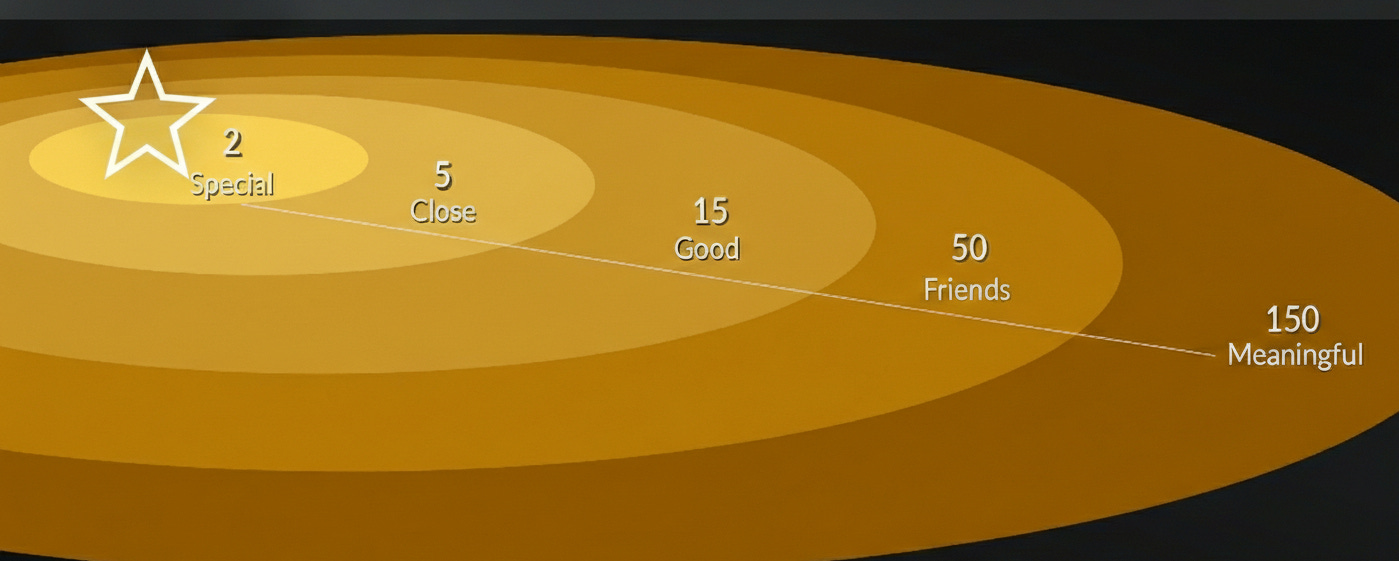
Consequently, humankind evolved unique ways to stay connected. This part of the evolutionary tale Professor Dunbar transmits is one of my all-time favorites. It turns out that our social workaround is a series of behaviors that we naturally love. They are laughing, feasting, singing, dancing, storytelling, and engaging in rituals. All of these experiences activate our endorphin without requiring time-intensive effort. This group of behaviors is known as the Human Social Toolkit. In my mind, it’s just the coolest toolkit on the market.
When we understand the important role the Human Social Toolkit plays in our lives, we come much closer to understanding why a night out at the theater or getting together with old friends can give us such a lift. Often, we walk away with a heart that feels clear and a mind that has been cleaned.
Dr. Anna Lembke & The Homeostatic Revelation
Next, I’d like to share a key lesson I learned from my interview with Dr. Anna Lembke. If I recall correctly, I interviewed Dr. Lembke in 2021. I was still very new to my podcast journey, and I remember being stunned that a guest on The Joe Rogan Experience and The Huberman Lab Podcast would talk to my boutique show.
As an addiction specialist at Stanford Medical and author of Dopamine Nation, Dr. Lembke brings well-earned compassion and perspective to this age of excess. You can hear my interview with Anna here: Episode #19: Dopamine & The Web of Pleasure. Also, if you know someone struggling with addiction, her book, Dopamine Nation, is rich with wisdom for those challenging dynamics of all forms of addiction.

With all that said, what still sticks with me all these years later is this: our notion of homeostasis is too small.
The homeostasis we’re taught in high school and college is isolated and abstracted. It seems that the homeostatic impulse is nothing more than the body’s moment-to-moment mechanisms that move it back to a central point of balance. Usually, homeostasis is only discussed in terms of pure biology. Body temperatures would be one familiar example. Our ability to shiver or sweat our way back to a livable core temperature is homeostasis at work.
When homeostasis is only viewed this way, it misses long arcs of time. It misses the subjective, psychological, narrative elements of our experience. Ultimately, the homeostatic impulse towards survival is also, to my eye, driving the psychological events of our lives. For example, maybe someone treats us poorly out in the world on a given afternoon. We might then seek to balance that hurt by seeking out some love from a close friend later that evening. Another example of the impulse towards balance occurs over the course of decades. I’ve noticed, and perhaps you have too, that people often seek to become the person they needed at a critical moment in their lives. This, too, is homeostasis.
We can further increase our perception of the homeostatic impulse by seeing it at play in our social experience as well.
Social Homeostasis and The Human Social Toolkit
As I wrote about in my post The Unapologetic American, there’s an illness in our country. The primary sign of it is the loss of empathy. Since I published that essay, I’ve noticed two episodes of “social homeostasis” emerging from our social distress. We might say these moments are erupting in response to imbalanced social pressures, as if the elements in the Human Social Toolkit were instinctively available to be drawn upon in hard times.
The first example is Singing Resistance Twin Cities. They are using the power of voice and song to help address the social pain their city has endured in recent months. Rather than the chants of “Hey, Hey, Ho, Ho, ICE has got to go!” They come at it from an entirely different tone. Melody and poetry that call to the heart. Take a listen to this clip and tell me if you don’t see a pain-relieving version of protest going on?
I find this vocal upwelling so profound that it made me well up. In the face of constitutional infringements and the brutality of force, citizens are choosing songs filled with the vibration of love. And by love here, we mean the pain-relieving force of the endorphin system that is activated with care. It seems to me that these voices invite healing and connection in a way that the adrenalized whistles cannot. I’m not saying there isn’t a role for the fight-or-flight system, but it is a different one than this.
To offer you more context, here’s a report about Singing Resistance Twin Cities on a local news station, in case you’d like to explore it a bit more.
Finally: Bad Bunny—The Storyteller
Like millions of others, I took the time to watch Bad Bunny during the Super Bowl Halftime Show. I also checked out his latest album, for which he won the Album of the Year Grammy. If you like a Latin pulse in your music, you’ll probably like his decidedly novel take on the Latin musical tradition.
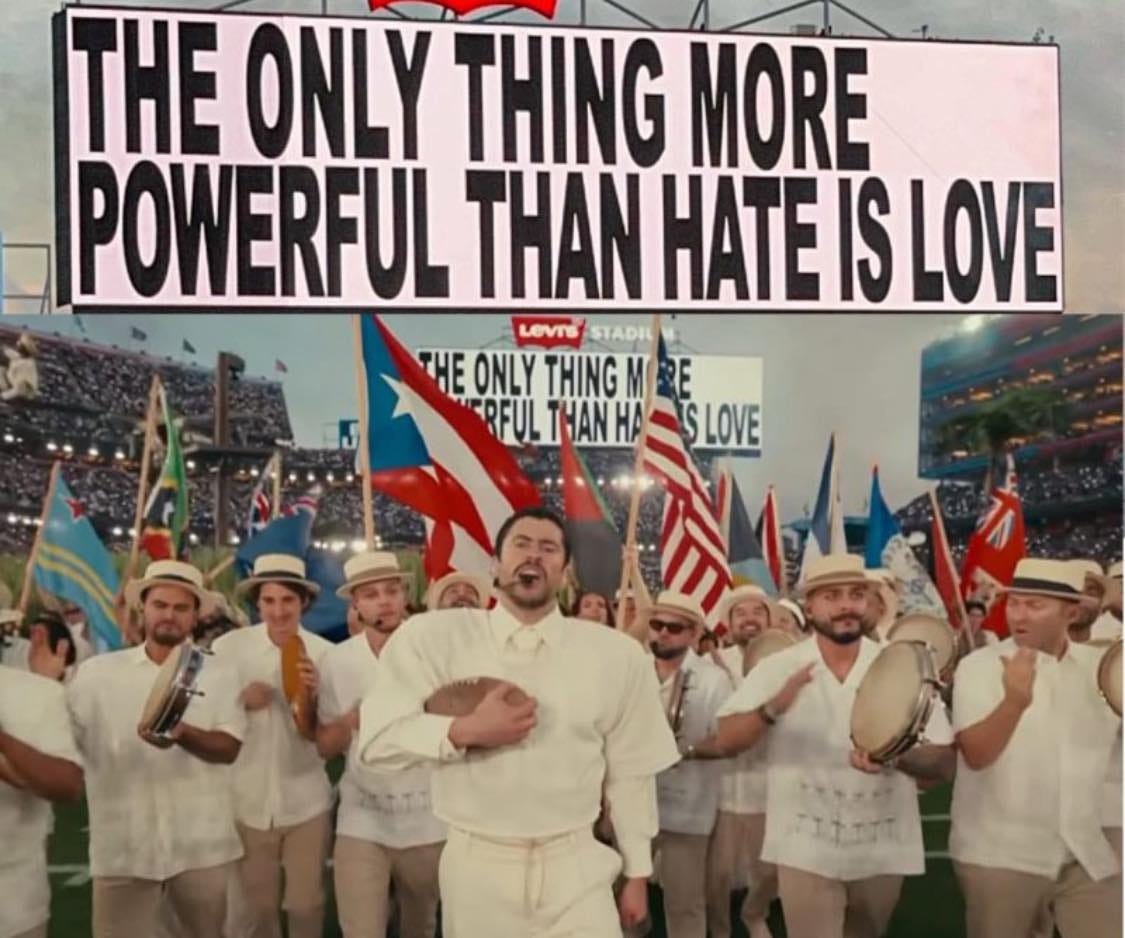
I see Bad Bunny’s performance as another indication of the Human Social Toolkit showing up to help us with our Social Pain. It was a delight to see how his performance staged a story. It was a story where Spanish speakers of the Americas celebrated the rhythms of their language, music, and culture. We saw vignettes of love, sharing food, dancing, living with kindness, and many other humanizing motifs. This was just the kind of medicine my heart needed. For months, we’ve been inundated with portraits of Spanish-speaking people, citizens and migrants, being accosted, brutalized, and violated. In other words, we’ve all been sharing in the pain of the dehumanization of good-natured and everyday people on screens and, sometimes, in front of our eyes. I feel so thankful to Bad Bunny and all the people involved in creating a magnificent social ritual to throw off the poisonous narrative being served up by Trump & Co.
If you haven’t seen Bad Bunny’s show, you can check it out on YouTube.
Singing Resistance and Bad Bunny are vital reminders that in this world of many languages and lineages, the Human Social Toolkit is the most natural feature of our social selves. As the cold, unforgiving behaviors of this administration are sure to try to cast a spell of on us, it is helpful to know that laughter, singing, storytelling, and other social bonding resources are the best ways for us to warm up and stay rooted in the ancient energies of our human experience.